| |
I am curious about why certain areas are designated as National Parks.
Just what qualities deem one patch of land more precious than another?
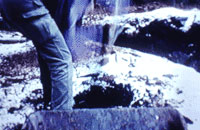
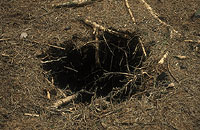
In March 1999 I was approaching the end of my degree at Sheffield Hallam. I journeyed from the University Campus and into the woods at the nearest point of the Peak District National Park to claim a piece of land for myself. I returned from inside the park boundary with a wheelbarrow of earth, pushing it the 3.27 miles to relocate it in a gallery space.
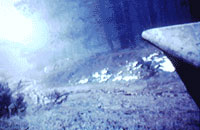
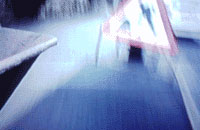
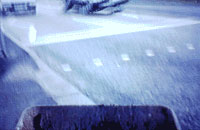
This arduous process was repeated each morning for five days, to form an increasingly large pile of excavated material. Each day a video camera was attached to the wheelbarrow to record the journey which upon arrival was immeadiately screened in the space on a monitor. A route map, a photograph and a progress sheet accompanied the installation to indicate time, space and duration. |
|
| |
The landscape was imposed upon
me through the physical action of repitition. This divided my surroundings into a series of parts, or minor events, with each footstep. In a sense it was an attempt
to understand the landscape through the simple action of walking through it
and also carrying a portion of it in the barrow.
By relocating the earth into a very public space, I was inviting the viewer
to scrutinise and perhaps judge for themselves the importance and preciousness
of this particular component of land. I had taken earth from one perceived area
of preciousness (the National Park) across a void to another (the gallery).
Did this then amplify the importance of the earth and did it validate the experience?
I would have liked to have been able to continue the piece for longer than was
possible at the time. Perhaps over a period of a month, a year, or enough time
to completely fill a space.
Actions on a grander scale...
Special thanks to Joff Whitton for technical assistance. |
|