inertia; a lexicon of modern movement


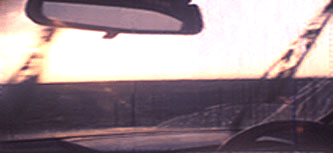
Through the toughened safety glass of a windscreen, for landscape to exist seems somewhat arbitrary.

Our notions of pure nature; wilderness, are pure fiction. To believe that nature could somehow still be even remotely threatening seems an outdated concept.

Acceleration further removes the permanence of land, changing ground into a semi surface, offering greater and greater degrees of abstraction. These are fluid transitions in various shades of green, a low maintenance landscape of ephemeral repetition and a fragile topography.


film stillfilm still


The relatively recent predominance of the automobile has provided our culture with an altered lexicon, a new dialect and perhaps a distorted language of land, transcribed in shorthand, and dispensing with traditional absolutes such as time, place and distance.

To view the land through the 'eyes' of a machine is to miss the point of the natural; it numbs any sense of feel for nature.

A driverless car renders itself obsolete as it gradually expires on an anonymous moorland. Left to define a syntax of circles in the ground, it leaves impermanent scars, slow motion ellipses of restricted movement.

The vehicle also negates a sense of time, place and distance, it has no destination, its landscape becomes non-linear and random. The realness of nature is as neglected and abandoned as the derelict car left to run itself into the ground.

Physical geography is replaced by virtual space.

In automobiles it is easy to glide between tracts of green-brown earth, on narrow slivers of grey tarmac. It is easy to by-pass nature without ever being a part of it.


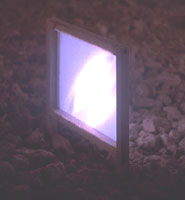
" inertia..." was installed at Rotherham Art Gallery from November 1999 to January 2000. For my first professional exhibition I was invited to produce a new piece of work. The installation utilised four super-8 and one 16mm film loop projected onto small screens set into a circle of roadstone.

Special thanks to Joff Whitton for technical assistance.


© 2000 Paul Anders Johnson